Secure Server Access in an Era of Network Isolation: Multi-hop Bidirectional Tunneling via the SSH Protocol
April 8, 2025
Overview
In today’s diverse business environments, organizations are actively employing various methods to restrict access routes in order to protect critical assets. Security solutions such as firewalls, access control lists (ACLs), and proxy servers play a crucial role in blocking unauthorized external access. These security measures have become essential in defending against increasingly sophisticated cyber threats.
Beyond basic network segmentation, many companies are now building multi-layered network environments with progressively segmented stages to further safeguard internal resources. While this strategy enhances security, it also increases the complexity of legitimate access paths. Tunneling technology based on the SSH (Secure Shell) protocol provides a powerful solution for establishing secure and efficient communication channels, even within such complex network architectures.
Problem Statement and Underlying Technologies
Access Challenges in Isolated Network Environments
Accessing internal servers within isolated network environments is often complex and cumbersome. Typically, users must traverse multiple Bastion Hosts (also known as Jump Servers), requiring them to know the connection details—such as IP addresses, ports, and authentication credentials—for each intermediary server. Additionally, users must authenticate at every step, resulting in a multi-stage connection process that significantly hampers operational efficiency and negatively impacts the user experience.
Capabilities and Limitations of the SSH Protocol
SSH offers robust encryption and authentication mechanisms, making it a widely adopted solution for secure remote server management and file transfers. Its port forwarding (tunneling) capabilities are especially valuable in environments with stringent network restrictions.
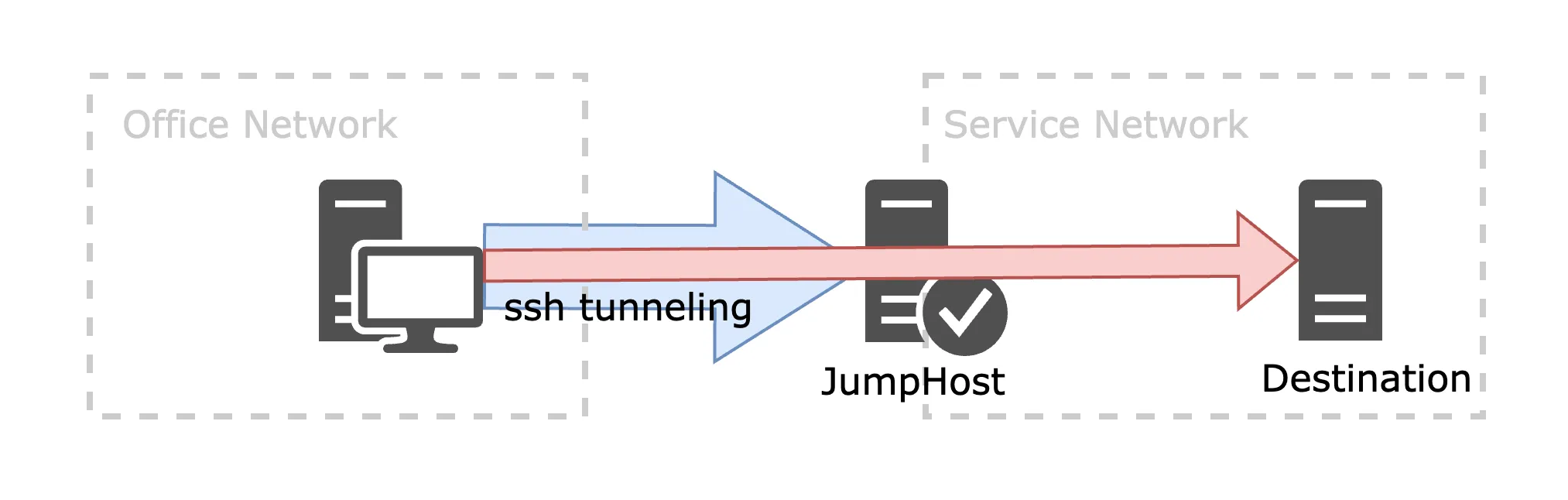
The SSH protocol partially addresses multi-hop access through its JumpHost functionality. By using the ssh -J option, users can connect to a target server via one or more intermediary hosts in a single command. However, this approach still presents challenges: users must have knowledge of the intermediary hosts’ credentials, which may conflict with internal security policies. Moreover, if this access information is exposed, it could be exploited by malicious actors, posing a significant security risk.
Inbound Access Restrictions and Reverse Tunneling
As security demands grow stricter, many organizations are implementing policies that completely block inbound access to their internal networks. In such environments, traditional SSH connections and JumpHost methods become ineffective for accessing internal resources.
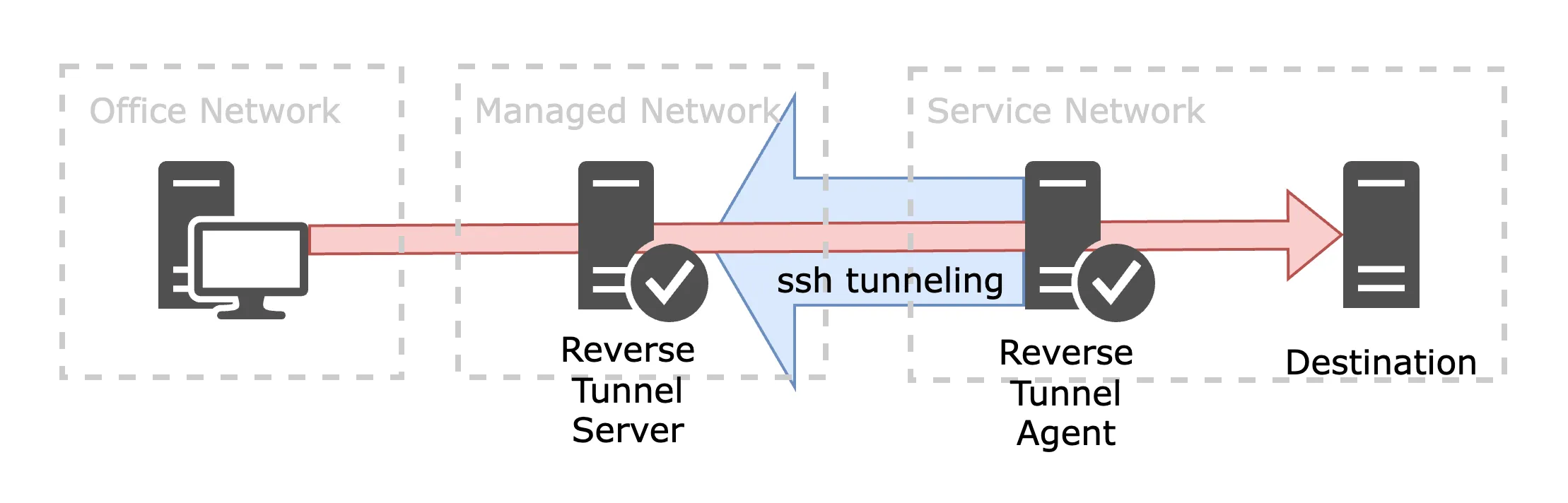
This is where Reverse Tunneling emerges as a practical solution. Reverse tunneling works by establishing a connection from the internal network to an external relay server, effectively enabling access to internal systems from the outside through that pre-established channel. Specifically, a server within the internal network initiates an SSH connection to an external reverse tunneling server. Once the tunnel is established, external users can securely connect to the internal server via the relay.
This method enables secure access to internal resources even when inbound traffic is fully restricted, ensuring compliance with strict security policies while maintaining essential accessibility.
Complexities in User Access Control
Although SSH-based JumpHost and reverse tunneling methods are technically viable, managing granular user access becomes increasingly challenging in large-scale environments. When multiple users require selective access to various internal servers, maintaining SSH keys and configuring access control policies can quickly grow complex and error-prone.
Moreover, routine tasks such as user account management, permission updates, and audit logging are often performed manually, leading to substantial administrative overhead and increasing the risk of misconfiguration or security gaps.
The Need for Alternative Technologies and Integrated Solutions
To overcome these challenges, agent-based access control solutions have gained traction. Open-source tools such as Teleport streamline SSH access while providing robust access control and auditing features. However, even these tools may require additional setup in multi-hop environments or networks with specialized architectures.
As a result, modern isolated network environments demand an integrated solution that meets the following criteria:
Users should be able to connect to target servers without needing to know the connection details of intermediary systems.
The solution must provide secure user authentication and fine-grained access control.
Internal resources must remain accessible even when inbound traffic is fully blocked.
Administrators should have the ability to centrally monitor and audit all access activities.
High security standards must be met without compromising usability or operational efficiency.
QueryPie’s Solution
Simplified Access to Layered Networks
QueryPie delivers a seamless and intuitive access experience, even in complex, multi-layered network environments. Users establish a single SSH connection to QueryPie, through which they can securely access the required internal servers—regardless of the underlying network structure. This approach significantly enhances user experience while also strengthening security by eliminating the need to expose connection details of intermediary servers.