QueryPie Publishes Multilingual DLP Models Trained with NIPA GPU Support, Advances UEBA Research
September 19, 2026
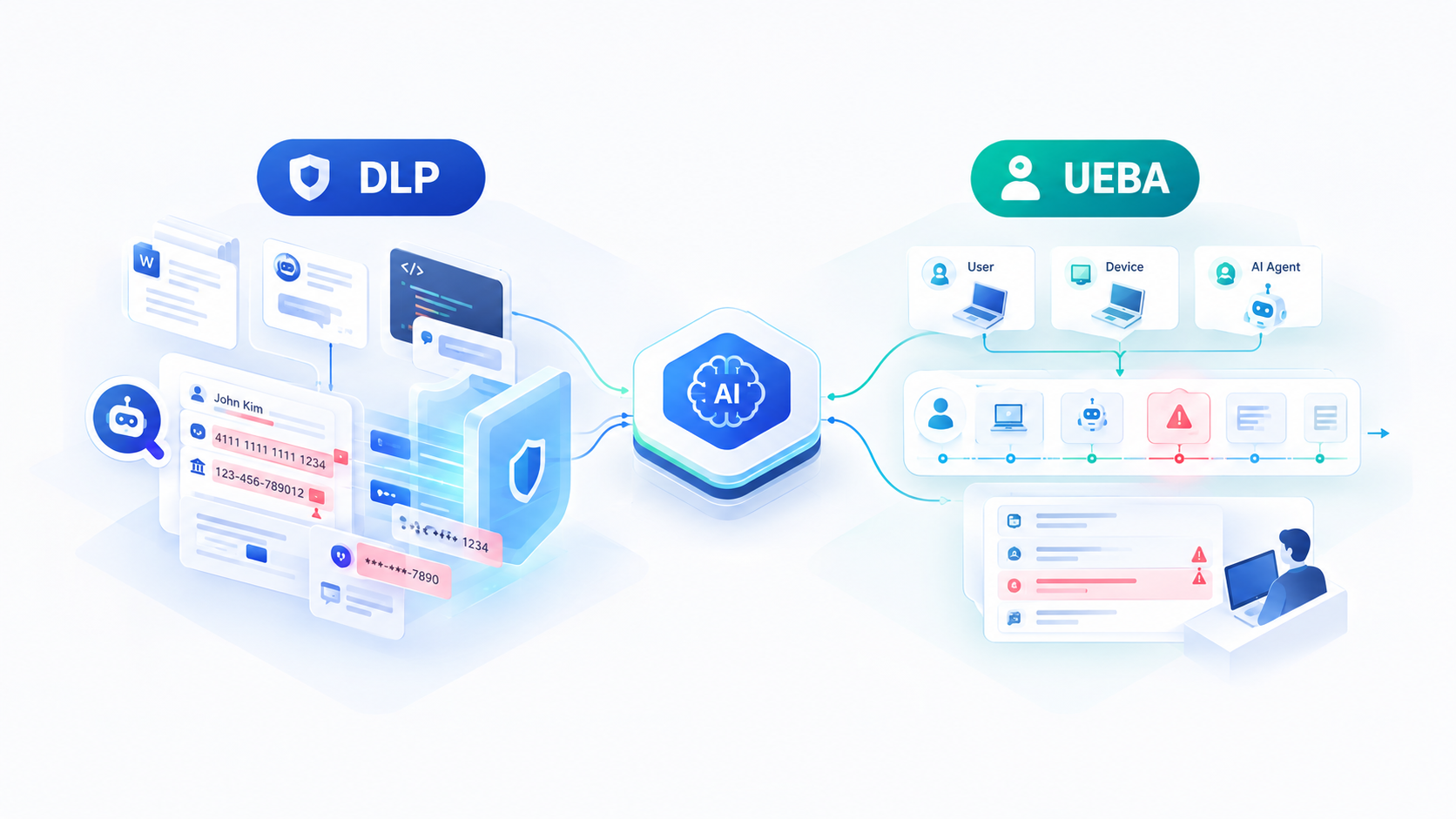
NIPA GPU support powers published multilingual DLP models as QueryPie advances UEBA research
QueryPie has published its multilingual Data Loss Prevention (DLP) AI models on Hugging Face. The models were trained using compute resources secured through the Advanced GPU Support Program led by the National IT Industry Promotion Agency (NIPA). By curating and expanding sensitive-data examples in Korean, English, and Japanese, then repeatedly training and comparing candidate models, QueryPie has advanced detection technology for enterprise AI environments.
Recent discussions with security teams at Korean enterprises surfaced two shared priorities: DLP and User and Entity Behavior Analytics (UEBA). As AI agents and MCP-based tools see wider use, teams must protect sensitive information sent to external AI services while also identifying unusual behavior in a growing volume of activity logs. The questions are complementary: what data needs protection, and which behaviors deserve attention first.
DLP must identify sensitive information embedded in documents, conversations, code, and AI prompts. UEBA must interpret activity logs across time and business context. Running every input through a large AI model would raise inference costs and require continuously available GPU infrastructure. An efficient screening layer narrows down what requires deeper analysis, making these capabilities more accessible to organizations without dedicated GPUs.
QueryPie is pursuing these challenges as two related research and development tracks: SLM-based DLP for data protection and UEBA for behavioral risk detection.
DLP: Screen for sensitive data quickly, then identify the exact text
At the front of the DLP workflow, regular-expression checks and a lightweight ELECTRA-based model screen large volumes of input for sensitive-data risk. Designed for use on CPUs, the Korean lightweight model recorded approximately 92% accuracy, 97% recall, and a 94% F1 score in internal evaluation, with an average response time of about 17.3 ms. QueryPie also trained and evaluated English and Japanese models for multilingual business environments.
A separate Gemma-family 12B small language model (SLM) extracts both the type of sensitive information and its exact wording from the source. A program compares each extracted phrase against the original text to calculate its character position. Trained and compared with NIPA-supported GPU resources, the precision model achieved the highest internal composite score, 92.64 points.
Enterprise teams also expressed a need for dynamic DLP that keeps sensitive source text away from external AI services while preserving the relationships and business context required for useful results. QueryPie's roadmap builds on type-and-phrase detection and programmatic position matching, linking those findings to organization-specific protection policies. Planned policy actions include blocking outbound transfers, highlighting or masking sensitive text on screen, warning users, routing cases for administrator review, and notifying security systems according to risk and policy.
UEBA: Understand scattered logs as a sequence of behavior
As AI agents and MCP-based tools become part of the audit scope, the volume of logs that security teams must review grows rapidly. In customer discussions, teams emphasized the need to surface significant activity for human review rather than read every record manually or send every event to a general-purpose AI model.
QueryPie's UEBA research and development focuses on sequences of user and device activity rather than isolated log lines. The model design brings together access times and locations, resources accessed, and data usage—signals that can appear ordinary on their own—then uses business context and event sequences to assess risk and provide supporting evidence.
UEBA is also being designed to narrow down important signals before deeper analysis, instead of sending every log to a costly general-purpose model. QueryPie is researching a standardized input format and ways to incorporate organization-specific context, including working hours and access policies. The goal is to lower inference costs with a compact SLM and broaden applicability in CPU-centric enterprise environments.
Building on the multilingual DLP training and publication results from the NIPA-supported GPU program, QueryPie is advancing UEBA research in response to needs identified with enterprise security teams. Together, the two tracks address data and behavioral risk across enterprise AI workflows.
Model and Download Resources
- QueryPie Hugging Face: https://huggingface.co/querypieai
- How to Download from Hugging Face: https://youtu.be/uNi4kYGPPUA