Shell Native Command Control through SSH Proxy Architecture
November 22, 2024
Introduction
Server access control solutions are essential security mechanisms that protect servers, which are among a company’s most critical assets. The core of server access control solutions is to track and manage which users access which servers and execute which commands. Traditional server access control solutions buffer each character input by a user, just like a virtual terminal, until the user presses the Enter key, and then combine the inputted characters to form the command the user intends to execute. However, this approach not only requires significant development time and costs, but it also becomes extremely difficult to parse the exact command if the user inputs the command using shortcuts or various key combinations. To address this challenge and enhance command parsing accuracy, QueryPie has developed a technology for command auditing and control using shell scripts.
Issue to Solve
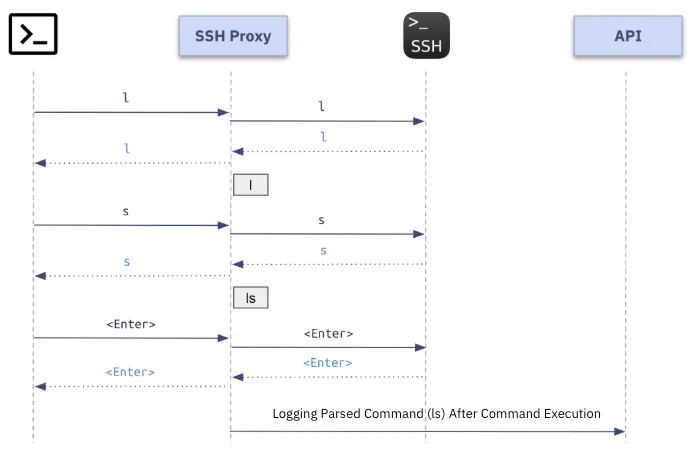
When an SSH session is established, data communication between the client and server occurs character by character as the user inputs commands. The format used for this communication is ANSI codes, which include various ANSI escape sequences employed for controlling the output format in terminals. Given that these sequences are part of the string stream, accurately parsing the user-entered command from this stream is as complex as creating a virtual terminal. As a result, most server access control solutions focus more on logging activities than on accurately parsing commands to block dangerous ones, which implies that vulnerabilities still exist in server security.
In particular, when it comes to server commands, users can bypass them through shortcuts or aliases, for example. Even if a server access control solution specifies prohibited commands, the same commands can still be executed by embedding them within scripts. Common server access control methods, such as those in a man-in-the-middle (MITM) proxy server that combine user input to parse commands, cannot effectively defend against such bypass attacks. Therefore, to enhance security, control should be implemented at the server level, such as by installing an agent on the server and running a daemon to monitor processes, rather than relying on proxy-level control.
Want to see more?
Fill out the form to unlock the full content.